Migration, Myths, and Self-Deception
Author: Nura Aslan
Inspired by the documentary film “They Stole My American Dream”
Introduction
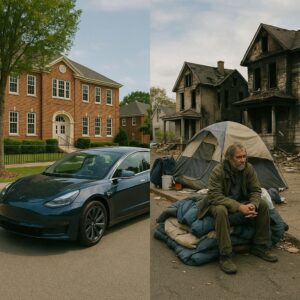 America is a country of contrasts. In one neighborhood—Teslas, private schools, and gleaming supermarkets. In another—tent encampments of the homeless, burnt-out houses, and fear of a hospital bill. Nevertheless, in the stories of many Russian-speaking emigrants, the USA remains a land of light, freedom, and comfort. And Russia—darkness, poverty, and hopelessness.
Why does this happen? Because the comparison is almost always unfair. We place Manhattan next to Murmansk, Silicon Valley next to Voronezh. We compare the best in one country with the worst in another. This is how the illusion of “real life” emerges: as if everything “there” is arranged correctly, while “here” is hopeless.
But every country has both light and shadow. It all depends on what we look at and what we want to see. This article is about why emigrant admiration easily turns into ideology, how personal choice becomes a collective position, and the homeland becomes just a crude caricature.
Why Emigrants Think Everything Is Better in Another Country
Emigration is not just a change of country. It’s an attempt to start over. A person leaves not only external circumstances but also themselves—their fatigue, disappointments, and feeling of stagnation. To believe that life has changed for the better, the psyche restructures perception.
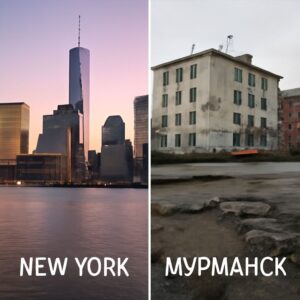 The new is perceived as better. Clean streets, polite people, a different rhythm of life catch the eye. And everything connected with the past becomes a dull background: rudeness, potholes in the roads, a general feeling of hopelessness. Even if in Russia a person had a stable job, family, and free healthcare—this fades into the background. Because admitting the shortcomings of the new country means doubting one’s own decision, which came at a high cost.
There is also social pressure. You want to appear confident. You don’t tell friends and family about doubts—only about successes. Thus, gradually an image of the new life emerges, which the emigrant themselves comes to believe. Although behind this facade, there may be hard work, loneliness, and constant stress.
What also matters is which country a person left and which they came to. In Russia, it is accepted that the state should treat, teach, and support. In the USA, the approach is different: every man for himself. You want to—fight your way. You don’t want to—no one will save you. For some, this feels like freedom. For others, like cold. In such a system, the previous model begins to seem like a prison, and the new one like fresh air. Although in essence, they are just different rules of the game.
True freedom begins with giving up expectations. When you stop waiting for someone to be obliged to help and start seeing things as they are. Acknowledging imperfection is not a defeat. It is maturity.
Where the West is Different: Social Contrast with America
It’s important to understand: even those who consider the USA a dream country often see not the real system, but a collective image inspired by media and other people’s stories. But the “West” is not homogeneous. Different countries offer different conditions—and America does not always look advantageous in this comparison.
Here, for example, is a comparison with Canada—a country with a similar standard of living and cultural code, but with a different social policy: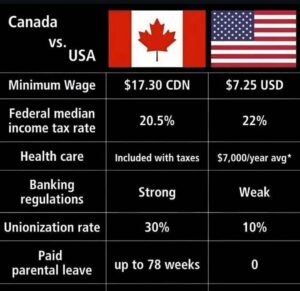
“Comparison of Social Indicators in Canada and the USA (according to 2023 data)” The table below shows key indicators reflecting the basic living conditions in the two countries:
As can be seen, Canada offers a higher basic level of social protection under a comparable tax burden. Public healthcare, paid parental leave, support for labor through unions, and banking regulation create a more stable environment, especially for families and vulnerable categories.
The USA, in contrast, is oriented towards individual responsibility and the market. There is more freedom here—but also more risks. No guaranteed paid parental leave, high healthcare costs, and weak worker protections make the system vulnerable for those who find themselves outside the stable middle class.
Unfair Comparison
When a person wants to convince themselves that they made the right choice, they start comparing. But such comparisons are often dishonest. We do not compare similar cities or conditions. We place the outskirts of Moscow next to the center of Miami. Or we contrast an old house in Ryazan with a clean street in California. But what about Chicago in winter? Or the slums of Los Angeles? They are simply not shown.
This is a technique of scale substitution. Instead of equivalent objects, favorable examples are chosen. It’s like praising American salaries while forgetting to mention the cost of rent. Or admiring the roads without mentioning how much car repairs cost in the USA.
Another technique is choosing a convenient frame. Photos on social media of a person drinking coffee against a backdrop of skyscrapers do not show reality. Only the facade. But real America is not just New York. It’s thousands of small towns where there is no public transport, no healthcare without insurance, and there is a fear of losing your job. Such places simply don’t make it into the lens.
There is another important factor—context. In Russia, someone encounters rudeness at a clinic—and this immediately becomes a reason for comparison. In the USA, if an insurance company denies treatment, they might not talk about it. Or they perceive it as an exception, not as a system.
This is how an image gradually forms: the new country is order, cleanliness, and justice. And the old one is dirt, absurdity, and provincialism. But if you dig deeper, it turns out the difference is not so much between countries, but between expectations and reality.
Comparing is useful. But only honestly. If comparison becomes a way of self-affirmation or propaganda, it turns into an illusion. And living in an illusion means not seeing what is really happening.
Roads
One of the most persistent ideas about America is the notion of flawless roads. In conversations among emigrants, they often become a symbol of “civilized life”: the idea is, if the asphalt is smooth, then the country works. Often, comparisons start with roads: look, they have order there, but here we have potholes and dirt.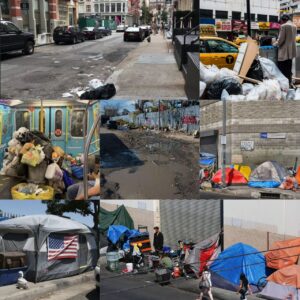
Yes, the USA indeed has excellent highways—smooth, wide, clean. Especially on federal interstates between major cities. They are pleasant to drive on, impressive in scale and quality. But this is only part of the picture.
Turn off the main routes, and the quality drops sharply. In residential areas, small towns, and rural areas, roads can be in the same condition as in the Russian hinterlands. Potholes, cracks, patches, unlit shoulders—all of this exists in America; it’s just talked about less. In poor areas, roads can be not only bad but also dangerous due to lack of repairs.
According to the American Society of Civil Engineers (ASCE), 43% of roads in the USA are in poor or mediocre condition. In California, potholes are common. In Michigan, the asphalt goes away with the snow in spring.
But in the emigrant environment, these details are often forgotten. People remember the smooth highway they drove on from the airport but don’t see how the majority of the population lives outside tourist routes. Add to this movies, bloggers, and advertising, which always show smooth asphalt—and an illusion is created that it’s like this throughout the country.
In reality, America is heterogeneous. It truly has excellent roads—and it has destroyed asphalt. Just like in Russia. The difference is only in what we choose to compare—a highway or a country road.
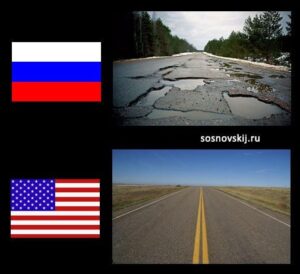
Photo 1. A Typical Comparison on Social Media
This image has become a visual cliché: Russia — darkness, potholes, hopelessness. The USA — smooth asphalt, order, open space. It is posted in stories about “escape from hell,” about “civilization,” about how everything “there” is arranged, and “here” is a failure. But in reality, this is a technique of visual manipulation. It’s not just comparing roads—it’s comparing extremes, substituting scales and context. They place a broken road from northern Russia next to a new highway in Texas. It’s like contrasting a rural hospital with a private clinic in Zurich. And if you remove the flags and imagine both photos are from the same country—would the effect be the same?
Photo 2. How People Imagine Roads in the USA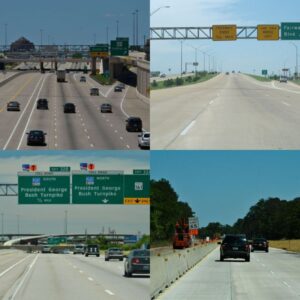
People imagine that all of America is like these highways: smooth, gleaming, fast. This perception is largely shaped by movies, advertising, and travel blogs. It’s precisely these sections—wide freeways, bridges, interchanges—that most often get captured on camera. Especially in the Southern and Western states: Texas, Arizona, California. Here you can indeed find highways that are pleasant to drive on for hours. These roads are a symbol of the American Dream. They are filmed with drones, used in screensavers and travel shows. But it’s important to understand: this is not all of America, but merely its showcase. Beyond the highways, a completely different road reality begins—as heterogeneous as the country itself.
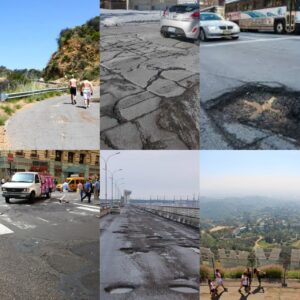 Photo 3. Another Reality—Also America
This is also the USA. And not some forgotten villages—but Los Angeles, New York, Boston, Philadelphia. These are the very cities many emigrants strive for, imagining gloss, cleanliness, and order. But just turn off the tourist route—and broken streets appear: potholes, cracks, patches, dirt, trash, and roadsides that haven’t been repaired for years. After winter, the situation is particularly severe—the asphalt literally crumbles under the wheels. In poor areas, it’s even worse: due to lack of funding and prioritization of other tasks (like safety or social assistance), roads are not just neglected—they become dangerous. According to the ASCE report, 43% of all roads in the USA are in poor or mediocre condition. These are not exceptions. This is a systemic problem that exists in parallel with the dream highways. It’s just not filmed with drones and not posted on Instagram. So it’s more honest to say: America has both excellent highways and destroyed asphalt—just like in Russia. Only we choose what exactly we want to see.
Healthcare: Between Myth and Reality
 One of the most persistent myths is that everything in the USA is free with insurance. In reality, insurance is not a guarantee of free healthcare, but a paid subscription with limitations and risks.
The average cost of insurance for a family is about $22,500 per year, of which the employee pays approximately $6,000. Over 30 million people in the USA have no insurance at all. Even those who are insured often face co-pays and deductibles. This means that for many procedures, you have to pay out of your own pocket—even with “good” insurance. Often these amounts are 20-30% of the total cost of treatment.
According to research, more than 40% of Americans delay visiting a doctor due to high cost. Calling an ambulance can cost between $1,200 and $3,000—and that’s just for transport, not including treatment. All of this makes healthcare in the USA not part of a social system, but a commercial service. If you don’t have a stable income, the system shows its teeth.
From the outside, it may seem that healthcare in the USA is high-tech and clinics are modern. And this is true—but only in the part where the patient has money or good insurance. For the rest, it is a market where a person’s health directly depends on their financial capabilities.
How Much Does the Average American Spend on Healthcare Per Year?
In the USA, the healthcare system is largely privatized, and a significant portion of the costs falls on the shoulders of citizens. The table below shows the main categories of expenses for the average American on medical care per year.
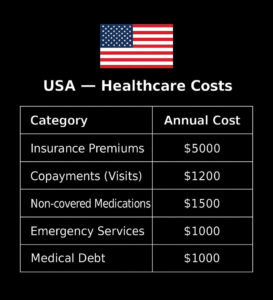
Insurance Premiums — about $5,000 annually. This is the amount citizens pay for health insurance, often through an employer or individually.
Co-pays for Visits — an average of $1,200. Despite having insurance, patients pay out-of-pocket for each doctor’s visit.
Medications Not Covered by Insurance — around $1,500 per year. Many medications, especially rare or brand-name drugs, are not included in insurance plans.
Emergency Medical Services — $1,000. Emergency care in the USA is often particularly expensive.
Medical Debt — another $1,000. Even with insurance, many Americans have to take out loans or pay off debts for medical services received.
Total annual expenses can exceed $9,700, highlighting the significant financial burden on citizens and the vulnerability of a system without universal insurance coverage.
Conclusion: Americans spend substantial amounts on healthcare every year, even when they have insurance. The system remains expensive and not always accessible to everyone.
Education: Knowledge at a High Price
The education system in the USA depends on the area of residence. Schools are funded by local property taxes. In wealthy areas—modern buildings, IT programs, school psychologists. In poor areas—overcrowded classrooms, outdated textbooks, and high crime rates on school grounds.
For a child to get into a good school, families often have to move to a different area, where rent can be two to three times higher. Quality school education becomes a matter not of rights, but of income.
As for universities—tuition at private institutions averages $30,000 to $50,000 per year. Even public universities cost $10,000–$20,000 per year. This leads to an enormous debt burden: total student debt in the USA exceeds $1.7 trillion. More than 43 million people owe banks for their education.
These debts directly impact lives. Young people delay buying homes, starting families, having children. Many work for several years just to cover the interest on their loans.
What’s more important—the level of knowledge does not always match the cost. According to the 2018 PISA international test, the USA scored 478 points in mathematics, Russia scored 488, Germany scored 500, and South Korea scored 526. Meanwhile, education in Russia is free for most students, and paid tuition at public universities costs between $1,000 and $3,000 per year, without accumulating debt.
In Germany, higher education is almost completely free, even for foreigners. In South Korea, it costs 5-6 times less than in the USA, and students show some of the best results in the world.
The conclusion is obvious: in the USA, access to a good education is possible, but it comes at a high price. Moreover, the high cost does not guarantee high results. This is the main difference—knowledge has become an expensive product, not a basic opportunity.
Comparison of Mathematics and Science Results (PISA, 2018)
 Let’s look at the table below, which presents the results of the international PISA 2018 study (Programme for International Student Assessment), conducted among 15-year-old students worldwide. The study assesses the level of student preparation in key subjects—mathematics and science.
The graph shows the scores of four countries—the USA, Russia, Germany, and South Korea. The average score on the PISA scale is 500 points, which allows for comparing the educational systems of different countries.
Mathematics Results:
· South Korea — 526 (significantly above average)
· Germany — 500 (exactly at the average level)
· USA — 495 (slightly below average)
· Russia — 478 (below average)
Science Results:
· South Korea — 519
· Germany — 503
· USA — 502
· Russia — 480
Conclusion: The results of the PISA 2018 study demonstrate a clear difference in the level of school education between countries.
South Korea confidently holds leading positions in both subjects, reflecting the effectiveness of its education system, oriented towards high academic results.
Germany shows stable indicators, close to the PISA average, confirming the quality of its traditional and structured educational model.
The USA, despite its high level of universities, lags in school education, especially in mathematics.
Russia shows the least high results among the represented countries, which may indicate the need to reform teaching approaches and school preparation.
These differences underscore the importance of investing in basic school education as the foundation for students’ future success and the country’s economy as a whole.
Or Maybe Not America?
When it comes to the “best standard of living,” the comparison is usually between the USA and Russia. Salaries, healthcare, safety—all of this is important.
But behind the numbers, the main question is often lost: how does a person actually live? They work, rest, sleep—but why do they do all this? To be happy—or to survive? The problem is not money. The problem is philosophy. In that, in some countries, a person is a system, while in others, they are a living being with the right not to be efficient 24/7.
Russia and the USA: Two Extremes of One System
Russia and America seem like opposites. But in relation to labor, they are different poles of the same exhaustion.
In Russia—a habit of survival. Working “three jobs,” not taking sick leave, carrying everything on your shoulders and enduring. There is heroism in this, but no self-care.
In the USA—a cult of productivity. Not just working, but self-actualizing, squeezing out the maximum, being useful, being better. Here, it’s shameful to rest. A two-week vacation—and you should already feel guilty. Even on weekends, people answer emails and fear “falling out” of the race.
Both Russia and America make labor the main form of social value. You either fight—or you are nobody.
And in Europe—it’s different
But there is a third way. It is especially clear in Southern Europe—in Spain, Italy, France.
There, they don’t dream of “making it.” There, they don’t consider overtime as heroism. There, work is part of life, not all of life.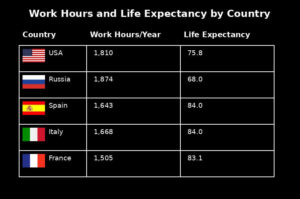 Let’s look at the table—it speaks for itself.
Fewer working hours. Higher life expectancy.
Happiness—not an abstract concept, but a quite measurable index.
Spain
Average annual working hours: 1,643
Life expectancy: 84 years
Happiness Index (2024): 6.4 / 10
In Spain, the workday often ends earlier than in the rest of Europe. In the middle of the day—the siesta.
Yes, it hasn’t remained in its original form everywhere, but the rhythm itself persists.
People go home, have lunch, rest.
Dinner—closer to 9:00 PM or 10:00 PM, often with the whole family.
The Spanish know how to switch off, know how to live outside of work, and are not ashamed of it.
And even with high unemployment, they regularly rank high in life satisfaction surveys.
France
Average annual working hours: 1,505
Life expectancy: 83.1 years
Happiness Index (2024): 6.7 / 10
In France, the “right to disconnect” law is in effect—employers are forbidden from contacting employees after work hours.
Lunch lasts from 1 to 1.5 hours.
Sunday is still a “sacred” day: shops are closed, streets empty, everything comes to a standstill.
The French see no point in devoting more time to work than necessary.
They do not believe that success requires sacrificing your personal life.
Italy
Average annual working hours: 1,668
Life expectancy: 84 years
Happiness Index (2024): 6.5 / 10
In Italy, life and work coexist on equal terms.
From 1:00 PM to 3:00 PM — riposo, a break.
Business may stop, streets may empty.
Family, socializing, tranquility—these are key cultural values.
Working until night is not considered a sign of strength; on the contrary, it signals that you don’t know how to organize your life.
Italians do not shirk responsibility—they refuse to sacrifice themselves unnecessarily.
Conclusion: while the USA and Russia compete with each other in “efficiency,” the countries of Southern Europe build life around the person, not around KPIs.
And the results speak for themselves:
· Life expectancy is 8–16 years higher
· Happiness indices are stable
· Working hours are fewer
· And most importantly—living there is not considered a weakness.
Crime and Safety: Romance with a Gun
There is a myth that America is a safe country where people smile and the police will always help. In reality, the situation is much more complex and depends heavily on the specific city and area.
 Cities like Detroit, Baltimore, St. Louis, Chicago, and Memphis are among the most dangerous in the USA. In some areas of Los Angeles, New York, or Houston, locals advise not to get out of your car at night. According to the Gun Violence Archive, more than 40,000 people die from firearms in the USA every year. This includes homicides, suicides, and accidents. In 2023, there were over 600 mass shootings in the country. Schools install metal detectors, conduct evacuation drills, and students live with the thought of potential threat from childhood.
In Russia, the problems are different. The main risks are domestic violence, street aggression, and police passivity, especially in the provinces. However, mass school shootings, as seen in the USA, are practically non-existent. The population is not armed, and the overall accessibility of weapons is much lower.
In terms of homicide rate, Russia lags behind many American metropolises. This does not mean that Russia is safe—just that the threats are different. If in the USA a person fears being caught in gunfire in a store, in Russia they fear facing inaction or rudeness in an emergency situation.
Both systems are unsafe, but in different ways. In one, there is a constant threat of armed violence; in the other, a fear of being left without help. Neither experience should be idealized—it’s important to understand what the risk actually entails.
Why Russia Is Demonized
 In emigrant circles, conversations about Russia often turn into a stream of irony and humiliation. This is not so much personal pain as a group mindset. Speaking well of the country you left is considered a sign of naivety. But sarcasm and criticism are perceived as maturity, as a sign of “I am no longer from there.”
This is how adaptation through opposition works. To become “one of us” in a new culture, a person distances themselves from the past. They no longer say “I left Russia,” they say “I escaped from hell.” This sounds brighter, simpler, evokes sympathy and recognition. Over time, this presentation becomes the norm. Especially in the information space. YouTube and TikTok algorithms promote videos with headlines like: “Here’s why I won’t return to Russia,” “10 horrors of life in the Russian Federation,” “After America, no desire to go home.” Moderate voices get lost. Sharp ones gather millions of views.
This creates a bubble effect. A person constantly hears the same thing: Russia is devastation, aggression, hopelessness. And the West is comfort, freedom, order. Even if the emigrant themselves doesn’t think so, the flow of content shapes the general mood. Criticizing Russia is normal. Praising it is shameful.
As a result, reality disappears. Russia is a huge and contradictory country. It has cruelty and injustice, but it also has warmth, vibrant communities, and strong people. The same goes for the USA: here there is comfort and opportunity, but also fear, loneliness, and inequality. Demonization is the same illusion as idealization. Only with the opposite sign.
When a person replaces a living, complex country with an image of absolute evil, they stop understanding where they come from. And that means they lose a part of themselves.
Cognitive Distortion: America Does Not Equal “Well Done”
 When it comes to the success of the USA, we are often presented with an image: look, Silicon Valley, the stock exchange, the global dollar, technology leaders, venture capital, innovation. And people sincerely think that all this is the result of the “American way of life.” That, supposedly, if you work hard like an American, you will become like Steve Jobs. But this is a typical cognitive distortion.
In reality, the success of the USA is not the success of its people. It is the success of capital. It does not have to be connected to a way of life, to hard work, to character. It is connected to where and under what conditions capital found it convenient to exist. And America simply turned out to be that territory—by pure historical logic.
California is not equal to all of America. Silicon Valley is not typical American life. It is a narrow elite sector where the best of the best from around the world work, but certainly not the majority of Americans. The fact that it “pulls the US economy” does not make the average resident of Iowa a participant in innovation. It’s like thinking you’re a co-author with Elon Musk just because you live in the same country.
The stock exchange is not a popular achievement. After World War II, the USA became the only major player with an undestroyed economy. It was then, in 1944, at the Bretton Woods Conference, that the dollar was officially established as the world reserve currency. And when in 1971 the USA decoupled the dollar from gold, they gained the ability to print money in any volume, competing with no one. That is, the status of the dollar is not the result of the people’s hard work, but a historical and political construct based on military and economic monopoly.
The reality in the USA is much harsher than its picture. People work 60–70 hours a week. They are afraid of losing their insurance. They take out 30-year mortgages.
They burn out, they don’t rest. They accumulate debt for education. Essentially, they live in a system where success is possible—but only for a few. For the rest, there is insomnia, loans, antidepressants, and no vacation.
And all this is despite the fact that these very people are often considered “lucky” simply because they were born in the territory where capital is based. This is the survivor’s error. When a person lives not richly, not freely, but thinks they have won in life just because of their passport.
But capital doesn’t need countries. It has no citizenship. It simply concentrates where it is convenient. And if tomorrow it becomes more profitable elsewhere, it will leave. And the people will remain. With their debts, tired bodies, and the illusion that they are part of a “great country.”
In reality, it’s not the country that wins. It’s just that it is the office rental space for capital. Temporarily.
What Self-Deception Leads To
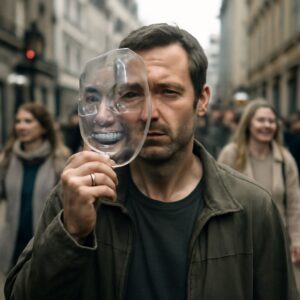 When a person lives for years in a distorted picture, where one country is an ideal and another is the source of all ills, they gradually lose contact with reality. They don’t just believe in a beautiful story—they adjust their entire life to fit it. And everything that doesn’t fit this scheme causes irritation, anxiety, or shame.
Self-deception helps not to feel pain. It allows you not to regret the break with the past, not to doubt decisions made, not to admit that the new life is also exhausting. But such an approach has a price: it makes a person blind to the present. It prevents them from seeing how the world around them works, from honestly discussing difficulties, and from understanding what they really want.
Often such people find themselves in a state of limbo. They don’t feel “at home” either there or here. It seems to them that everything is bad in Russia, but in the new country, there is also no sense of support. They find it hard to make plans, to go back, to admit doubts. Hard to simply be—without excuses and slogans.
Another problem is the impossibility of open conversation. When a person constantly proves that everything is fine with them, they distance themselves from loved ones. They cannot say: “I’m struggling,” “I miss you,” “I’m not sure.” Communication turns into a play of roles: the successful emigrant versus those who stayed behind. This destroys relationships and intensifies loneliness.
Self-deception hinders adaptation. While a person is busy maintaining the image of a “new life,” they may miss real opportunities. They fear admitting they don’t understand something. They close themselves off from the local culture. And in the end—they remain in isolation, even while being in the country of their dreams.
But the most important thing is that self-deception prevents you from being alive. And life is not only comfort and success, but also fear, doubt, and searching. Accepting this does not mean losing. It means growing up.
Conclusion
 The purpose of this article is not to whitewash Russia or to denigrate the USA.It is not about where it is better to live.
It is about how important it is to see reality without filters—and not to build your beliefs on illusions, fears, or grievances.
Every country is a system of compromises. Somewhere there is more freedom, but less support. Somewhere salaries are higher, but so is the risk of being left without insurance. Somewhere the bureaucracy is slower, but help is closer.
It’s important not to compare facades, but to understand what they are built on. When we compare countries, we must do so honestly—not based on YouTube videos, not on vacation photos, not on other people’s stories. But on facts, figures, personal experience, and our own values.
Emigration is a difficult step, unique to each person. But it does not require making a caricature of the past and a cult of the future. Reality is not perfect, neither here nor there. And it is precisely this understanding that makes a person truly free. And also—mortal.
We are all walking in the same direction. And at the end of the road, it does not matter how many hours you spent working, in which territory you lived, or how many followers you had. Only one question matters: did you have time to live? If not, no passport, no visa, no flag will help.
Links
1. Roads in the USA
· ASCE – Report on the condition of roads in the USA:
https://infrastructurereportcard.org/cat-item/roads-infrastructure
· CNBC – Problems with roads in the USA:
https://www.cnbc.com/2021/03/31/america-has-a-massive-road-problem.html
2. Healthcare and Insurance
· KFF – Annual report on the cost of health insurance:
https://www.kff.org/health-costs/report/2023-employer-health-benefits-survey/
· Healthcare.gov – Official website on insurance in the USA:
https://www.healthcare.gov/
· CNBC – 42% of Americans delay doctor visits due to cost:
https://www.cnbc.com/2023/01/19/42percent-of-americans-delay-medical-care-due-to-cost.html
· Healthline – Costs of ambulance services in the USA:
https://www.healthline.com/health-news/ambulance-costs-can-be-surprising
3. Education and Student Debt
· Federal Reserve System – Statistics on student debt:
https://www.federalreserve.gov/releases/g19/current/
· NCES – Cost of tuition in the USA:
https://nces.ed.gov/fastfacts/display.asp?id=76
· OECD – PISA 2018 Results:
https://www.oecd.org/pisa/publications/pisa-2018-results.html
· Gun Violence Archive
4. Crime and Safety
· Gun Violence Archive – Statistics on mass shootings:
https://www.gunviolencearchive.org/
· CDC – Statistics on firearm deaths:
https://www.cdc.gov/nchs/fastats/injury.html
· Investopedia
· +5
· ASCE’s 2025 Infrastructure Report Card |
· +5
· LendingTree
· +5
5. Additional
· Pew Research – Surveys of emigrants and perceptions of life in the USA:
https://www.pewresearch.org/
· The Atlantic – Visual manipulation on social media:
https://www.theatlantic.com/technology/archive/2021/10/instagram-reality-distortion/620377/
· Working hours (OECD 2023):
https://data.oecd.org/emp/hours-worked.html
· Life expectancy (Worldometer 2025):
https://www.worldometers.info/demographics/life-expectancy