
Work as Life. And Where Was Life? American Employment: When Pauses Are Not Provided
Author: Nura Aslan
Inspired by the documentary film “They Stole My American Dream”
Introduction
 For most Americans, work is not just a way to earn a living, but life itself. In a country where work weeks often stretch to 40-50 hours or more, and rest is hardly provided, work becomes an integral part of personal identity. But what happens when rest remains only a rare moment? How does this affect health, relationships, and personal happiness?
We live in a world where success is measured by labor, and rest is often perceived as a weakness. In the USA, for example, many women who have just become mothers are forced to return to work just a few weeks later, without having time to recover. But is such a life truly successful, or is it just a path to burnout?
This article is dedicated to the culture of “constant employment” in the USA, where work becomes the main meaning of life. We will compare this model with approaches in other countries, such as Russia and Europe, and explore how possible a balance between work and rest truly is. Can a person find this balance, or will their entire life turn into an endless pursuit of a career?
What are the conditions for people, how many hours do people work in the USA
 In the USA, the work culture is known for its focus on high employment. The average American works more than 40 hours a week. For many workers, this is not the limit, and actual working hours often significantly exceed the established minimum. The workday usually starts early and ends late, leaving little time for rest or personal life.
At the same time, the American labor system is characterized by limited vacation rights. On average, workers can expect 5-10 days of paid vacation per year, which is significantly less than in other countries where it is a guaranteed right for all employees. In some European countries, for example, Germany or France, vacation amounts to at least 4-6 weeks a year, which contributes to a better work-life balance.
Another feature of American work culture is how quickly women return to work after childbirth. Unlike most European countries, where extended maternity leave is the standard, such a practice is not supported at the state level in the USA. Women are generally forced to return to work soon after having a child to avoid losing their position and income.
Thus, the work culture in the USA is heavily oriented towards productivity and career achievements, which in turn impacts the personal time and health of workers.
Comparison with Russia, Europe, Japan, and China: Different Approaches to Work-Life Balance
 Let’s examine how this issue is addressed in the USA, Russia, Europe, Japan, and China.
USA
In the USA, the prevailing belief is that work is the primary path to success, leading to long working hours. Despite minimal paid vacation, Americans often work more than 50 hours a week. In large cities and competitive fields, overtime has become the norm. Workers worry that if they are not constantly in motion, they might lose their position. This creates tension and burnout, negatively impacting health and personal life.
Russia
In Russia, labor legislation offers more favorable conditions for workers. The standard workweek is 40 hours, and the duration of vacation is at least 28 working days per year. Additionally, Russia has implemented state support programs for families, such as maternity capital, which helps families with children. Longer maternity leaves for women are also provided. In recent years, employers have become more flexible, offering remote work and opportunities for a better work-life balance.
Europe
In European countries such as Germany, France, and Spain, workers are entitled to longer vacations — a minimum of 4-6 weeks per year. This allows people to rest and recharge, dedicating time to family and personal interests. In Sweden and Norway, additional measures have been developed to support mothers, including extended paid maternity leave and flexible conditions for returning to work. European countries actively support policies aimed at improving working conditions for women and promoting harmony between work and personal life.
Japan
 In Japan, work culture is characterized by strict norms and high discipline. The workweek here often exceeds 50 hours, and overtime is considered normal. Japanese people often do not take vacation, even when necessary, due to pressure from employers and a society where duty to work comes first. This leads to serious health consequences, including mental health problems and even deaths from overwork, known as “karoshi.” The emotional burden and constant stress have a devastating impact on Japanese society, and the problem of “karoshi” remains one of the most acute.
China
In China, work culture is also oriented towards strict discipline and long working hours. The standard workweek is 40 hours, but in some sectors, due to high competition and economic pressure, it can extend to 50 hours or more. Many Chinese workers do not have opportunities for rest and relaxation, leading to chronic stress. The psychological pressure on workers, especially in large cities, is growing, causing anxiety disorders and depression.
Below is a diagram comparing the number of vacation days and the average number of working hours in the USA, Russia, Europe, Japan, and China.

Comparison of Two Countries: The Netherlands and the USA
 Let’s compare two countries that approach the issue of working conditions from completely different perspectives in their cultural and social policies. The Netherlands and the USA are examples of two economically developed countries with high living standards, but with significantly different approaches to working hours, working conditions, and personal life.
Working Hours:
· In the Netherlands, the average working week is 27 hours, significantly lower than in the USA. This is the result of high flexibility in working time and a culture oriented towards work-life balance.
· In the USA, the standard working week is 40 hours, and in many industries, working hours can reach 50 hours per week. This intense work culture can cause burnout and increased stress.
Happiness Index (World Happiness Report 2024):
· The Netherlands ranks 5th in the world happiness ranking, with a happiness index of 7 (on a scale from 1 to 10). This high score is explained by the accessibility of social services, quality healthcare, and ample rest. Despite its high happiness index, the Netherlands is in fifth place due to other factors such as the level of social support and political stability, which strongly influence the overall happiness of the population.
· The USA ranks 15th with a happiness index of 6.5. Although the happiness level in the USA is also quite high, the more intense work culture, social inequality, and political instability lower the overall level of happiness, despite high income and opportunities.
Life Expectancy:
· In the Netherlands, the average life expectancy is 82.5 years. This is linked to a high level of healthcare, lower stress levels, and quality social support.
· In the USA, the average life expectancy is 79.5 years, lower than in the Netherlands. Although medical technologies in the USA are advanced, high work-related stress and lack of rest negatively impact citizens’ health.
 Paid Vacation:
· In the Netherlands, workers are entitled to 4-6 weeks of paid vacation per year, which promotes better recovery and stress reduction.
· In the USA, the average vacation is only 10 days per year, which is significantly less and limits time for rest and recovery.
Salary:
· In the Netherlands, the average salary is about $52,000 per year. Despite fewer working hours, the income level in the Netherlands is quite competitive, and the shorter work week helps maintain a healthy work-life balance.
· In the USA, the average salary is $58,000 per year. However, the higher income compensates for the additional working hours and stress, which can also affect the overall level of life satisfaction.
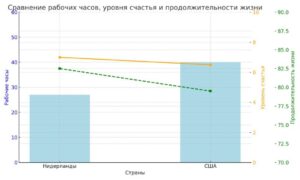
Thus, differences in working hours and social policy play a key role in determining the overall level of well-being in these countries.
Maximum Employment as a Culture in the USA
In the USA, high employment and the absence of pauses are not just a trend, but practically a cultural standard embedded in society. A system oriented towards workaholics glorifies career achievements as the main indicator of success. Working without breaks has become the norm, and success is measured by the amount of time a person spends on their career.
Social and Psychological Aspects
The American Dream: In the USA, there is an idealized notion of the “American Dream,” according to which success is achieved exclusively through hard work and the pursuit of career advancement. This belief is actively supported at all levels—from the education system to work culture. The prevailing opinion in society is that only constant activity and the pursuit of success can lead to financial independence and social stability. The logic is simple: if you don’t work constantly, you won’t achieve success.
Competition: Intense competition in the labor market, especially in large cities and highly competitive fields, pushes people into endless hours of work. People worry that if they don’t work without a break, their place will be taken by someone more capable, leading to losses not only in their career but also financially. This anxiety becomes the basis for career burnout and increased stress.
Psychological Pressure: In an environment where society actively values productivity, people begin to avoid rest, even when they are physically or emotionally exhausted. Workaholism is perceived as a sign of a strong and successful person, while rest and pauses are seen as weakness or a waste of time. This creates a vicious cycle: work becomes an end in itself, and health and personal life become secondary.
Below is a diagram comparing stress levels and illness rates among workers in the USA, Russia, Europe, Japan, and China.

Thus, the diagram demonstrates a clear relationship between stress levels, working conditions, and illness rates, highlighting the importance of a balanced approach to work and rest for improving worker health.
Examples of Real People Who Faced Workaholism and the Search for Balance
 1. Arianna Huffington (USA, New York)
Arianna Huffington, founder of The Huffington Post, is a striking example of how high employment and a culture of working without rest can negatively impact health. She openly spoke about her experience of “burnout” after collapsing from exhaustion and breaking her cheekbone in her pursuit of success and career achievements. This event became a turning point in her life, and she wrote the book “The Sleep Revolution,” in which she shares her experience and urges people to find a balance between work and rest.
2. James Rebhorn (USA, New York)
James Rebhorn, an actor who passed away in 2014, also experienced stress and burnout due to his professional life. Despite his heavy involvement in film and television, James realized the importance of paying attention to personal relationships and caring for his psycho-emotional state. This allowed him to get through difficult moments in his life, despite a serious illness.
 3. Sheryl Sandberg (USA, Menlo Park, California)
Sheryl Sandberg, former COO of Facebook, began actively speaking about the importance of maintaining a work-life balance after the sudden death of her husband. In her book “Option B,” she shares her personal grief and experience overcoming adversity. Sheryl emphasizes how societal expectations and job demands can be draining and talks about the importance of rest and recovery, even in high-level positions.
4. Richard Branson (UK, London)
Richard Branson, founder of the Virgin Group, acknowledges that success is not worth it if it comes at the expense of health. Despite his busy schedule, Branson actively supports a healthy lifestyle, including regular exercise and hobbies. He often emphasizes that to achieve long-term success, it is important not only to work but also to find time for rest and personal interests.
These examples show that even successful and highly effective people face the consequences of workaholism. Despite their career achievements, they understood the importance of finding a work-life balance. The stories of Arianna Huffington, James Rebhorn, Sheryl Sandberg, and Richard Branson highlight that for long-term success and personal well-being, it is necessary to take care of one’s health and emotional state, as well as to set aside time for rest and recovery.
Changing Work Culture to Prevent Burnout
 To avoid the negative consequences of workaholism, such as burnout, stress, and deteriorating health, it is necessary to reconsider not only individual approaches but also the overall work culture. It is important to understand that work is not the only component of life, and to maintain long-term well-being, it is essential to dedicate time to rest and personal life. In countries like Spain, Italy, and France, attention to rest combined with work culture helps avoid the negative effects of excessive employment.
Spain:
In Spain, there is the tradition of the siesta, a short rest after lunch, which helps avoid overload and regain strength during the day. This helps increase productivity and reduce stress levels. The siesta is not just a rest; it is part of a culture that emphasizes the importance of rest and recovery for effective work.
Italy:
In Italy, work culture is closely linked to family values and rest. Summer vacations, especially in August, become a time for recovery and maintaining family ties. Italy also actively supports a balance between working and personal hours, which helps people not only maintain high productivity but also preserve emotional health.
 France:
France is known for its system supporting the 35-hour work week and long vacations, which contribute to recovery and stress reduction. The French approach emphasizes that work should be part of a balanced life, not its dominant element.
By studying the examples of these countries, we can see how a culture of rest and attention to work-life balance helps prevent burnout and maintain high levels of happiness and health among citizens. To avoid the negative consequences that lead to workaholism and stress, it is important to change approaches at all levels—from individual to governmental. Balance between work and rest must become part of the overall culture, because only in this way can we create long-term conditions for a happy and healthy life.
Conclusion
 The purpose of this article is not to criticize the work culture in the USA, but to show how it affects the quality of life, level of happiness, and life expectancy. We are not trying to devalue success and achievements, but we aim to look at the reality that hides behind the endless race for career growth and material goods.
Life in the USA is indeed full of opportunities, but at the same time, it demands constant work and self-sacrifice. People often put their careers first, and in this process, they lose time for themselves—for rest, for family, for hobbies. In the end, many of us face the question: “What have I done for myself in my entire life?”
A work culture oriented towards intense labor, high expectations, and minimal vacations often leads to burnout and disappointment. Trying to achieve success in the professional sphere, we sometimes lose ourselves. Few people ponder what is more important—the endless struggle for success or time spent with loved ones and in the pursuit of personal happiness.
Unfortunately, in a culture where “work is success,” there is often no room left for life outside of work. And so you stand on the threshold of old age, realizing that you have lived almost all your time without pausing for true rest. What is this—success or a loss of life?
We must learn to find balance, to create a culture where not only work achievements are valued, but also time for oneself. Life is not only work; it is also the moments we dedicate to loved ones, our passions, and our inner world.
Links To Research
- Average Weekly Working Hours in the USA (April 2025)
Bureau of Labor Statistics – Report: https://www.bls.gov/news.release/pdf/empsit.pdf?utm_source=chatgpt.com - Paid Parental Leave Policy in the USA
OECD – Paid Parental Leave: https://www.oecd.org/en/blogs/2023/01/Paid-parental-leave–Big-differences-for-mothers-and-fathers.html?utm_source=chatgpt.com - Workplace Stress in the USA (2024)
American Psychological Association – Stress Report: https://www.apa.org/pubs/reports/stress-in-america/2024/2024-stress-in-america-full-report.pdf?utm_source=chatgpt.com - Quality of Life and Work-Life Balance in the EU (2024)
Eurofound – Quality of Life Data: https://www.eurofound.europa.eu/en/resources/data-story/2025/quality-life-eu-2024-results-living-and-working-eu-e-survey?utm_source=chatgpt.com - Book on the “American Dream”
The American Dream: A Short History of an Idea That Shaped a Nation: https://www.amazon.com/American-Dream-History-Shaped-Nation/dp/0195158210?utm_source=chatgpt.com - OECD: “How’s Life? 2024”
How’s Life? 2024 – OECD: https://www.oecd.org/en/publications/how-s-life-2024_90ba854a-en.html - Eurofound: “Work–life balance: Policy developments”🇪🇺
Work–life balance: Policy developments – Eurofound: https://www.eurofound.europa.eu/en/resources/article/2024/work-life-balance-policy-developments - World Happiness Report 2024
World Happiness Report 2024: https://worldhappiness.report/ed/2024/ - Germany: Work–life balance and happiness
Germany: Work–life balance and happiness – OECD: https://www.oecd.org/germany/ - Finland: Work culture and happiness
Finland: Work culture and happiness – World Happiness Report: https://worldhappiness.report/ed/2024/


 When a person moves to another country, they rarely take only a suitcase. They also bring their old mindset—attitudes, habits, expectations, fears. And here’s what happens: life abroad turns out to be difficult, alien, expensive. But instead of admitting this, the person begins to defend their choice at any cost: devaluing the country they left and idealizing the one they arrived in. “It was hell in Russia. America is paradise. I just didn’t adapt right away.”
 One of the most persistent distortions among those who have emigrated is comparing salaries “by hearsay” or “on paper” before taxes.
  In Russia, this is deeply ingrained—”medicine should be free,” “education must be accessible,” “the state should support you in difficult times.” A person may criticize the authorities, hate the system, but still expect help from it.
 What remains behind the scenes of someone else’s success:
 One of the favorite arguments: in America, supposedly, even billionaires can calmly walk the streets without security—such a free and safe country.
 We have analyzed dozens of interviews, videos, and posts from emigrants who returned home. And here’s what’s interesting: almost everyone explains their return with something soft and personal. They say — “I couldn’t get used to it,” “the culture there is alien,” “I had no friends,” “my heart wasn’t in it,” “the mentality wasn’t right.” In short, it all boils down to mood, feelings, atmosphere. And almost no one speaks directly about the real reasons — which are actually much harsher.
 Most people leave to finally—breathe a sigh of relief: a new country, new rules, “here it will definitely become easier.”
 Emigration in the past was about survival. It was a step into the void. People left because the alternative was death. War, repression, famine. They left their homeland in tears, with children in their arms, without knowing the language, without plans, without guarantees. They left not for “new opportunities,” but because staying was terrifying. It was an act of desperation. A feat, followed by pain, fear, and loss. Departure was perceived as a tragedy, not as a strategy.
 The new world used to be a different planet: unfamiliar products, foreign speech, a different rhythm of life. You changed countries—and lost everything familiar. It was a risk. It was an ordeal.
 This article is not about justifying one country and criticizing another. Nor is it about arguments over where it is better to live. It’s about something else—a sober look at things. About the truth that is easy to overlook.
 America is a country of contrasts. In one neighborhood—Teslas, private schools, and gleaming supermarkets. In another—tent encampments of the homeless, burnt-out houses, and fear of a hospital bill. Nevertheless, in the stories of many Russian-speaking emigrants, the USA remains a land of light, freedom, and comfort. And Russia—darkness, poverty, and hopelessness.
 The new is perceived as better. Clean streets, polite people, a different rhythm of life catch the eye. And everything connected with the past becomes a dull background: rudeness, potholes in the roads, a general feeling of hopelessness. Even if in Russia a person had a stable job, family, and free healthcare—this fades into the background. Because admitting the shortcomings of the new country means doubting one’s own decision, which came at a high cost.



 Photo 3. Another Reality—Also America
 One of the most persistent myths is that everything in the USA is free with insurance. In reality, insurance is not a guarantee of free healthcare, but a paid subscription with limitations and risks.

 Let’s look at the table below, which presents the results of the international PISA 2018 study (Programme for International Student Assessment), conducted among 15-year-old students worldwide. The study assesses the level of student preparation in key subjects—mathematics and science.
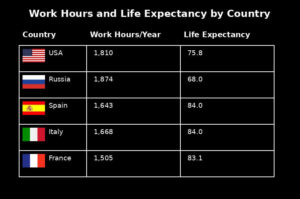 Let’s look at the table—it speaks for itself.
 Cities like Detroit, Baltimore, St. Louis, Chicago, and Memphis are among the most dangerous in the USA. In some areas of Los Angeles, New York, or Houston, locals advise not to get out of your car at night. According to the Gun Violence Archive, more than 40,000 people die from firearms in the USA every year. This includes homicides, suicides, and accidents. In 2023, there were over 600 mass shootings in the country. Schools install metal detectors, conduct evacuation drills, and students live with the thought of potential threat from childhood.
 In emigrant circles, conversations about Russia often turn into a stream of irony and humiliation. This is not so much personal pain as a group mindset. Speaking well of the country you left is considered a sign of naivety. But sarcasm and criticism are perceived as maturity, as a sign of “I am no longer from there.”
 When it comes to the success of the USA, we are often presented with an image: look, Silicon Valley, the stock exchange, the global dollar, technology leaders, venture capital, innovation. And people sincerely think that all this is the result of the “American way of life.” That, supposedly, if you work hard like an American, you will become like Steve Jobs. But this is a typical cognitive distortion.
 When a person lives for years in a distorted picture, where one country is an ideal and another is the source of all ills, they gradually lose contact with reality. They don’t just believe in a beautiful story—they adjust their entire life to fit it. And everything that doesn’t fit this scheme causes irritation, anxiety, or shame.
 The purpose of this article is not to whitewash Russia or to denigrate the USA.It is not about where it is better to live.