Cognitive Distortions of Emigrants: The Illusion of Change as a Form of Self-Deception
Author: Nura Aslan
Inspired by the documentary film “They Stole My American Dream”
Introduction
 When a person moves to another country, they rarely take only a suitcase. They also bring their old mindset—attitudes, habits, expectations, fears. And here’s what happens: life abroad turns out to be difficult, alien, expensive. But instead of admitting this, the person begins to defend their choice at any cost: devaluing the country they left and idealizing the one they arrived in. “It was hell in Russia. America is paradise. I just didn’t adapt right away.”
It sounds logical. Only it’s not true. This is self-deception, caused by cognitive distortions. That is—false perception patterns that prevent seeing things as they are. This article is not about where it is “better to live.” It is about why those who have left often cannot honestly assess what is happening to them after the move. And why, instead of a sober comparison, they fall into extremes, where one country becomes an enemy and the other an unattainable ideal.
Cognitive Distortion #1: Comparing Income Without Accounting for Expenses
 One of the most persistent distortions among those who have emigrated is comparing salaries “by hearsay” or “on paper” before taxes.
You hear: “He gets $8,000 a month in America,” and you automatically think: that means he lives many times better than me. In reality, it’s more complicated.
What is usually not taken into account in the USA:
– Taxes: 20 to 40% depending on the state
– Health insurance: $400–600 per month
– Rent: 50–70% of income, especially in cities
– Car: loan, insurance, gas, impossible to do without one
– Daily expenses: kindergarten, food, communication, internet, utilities—everything is higher than expected
In the end, from a “high” salary, a maximum of $700 may remain.
What is often not taken into account in Russia:
– Tax: 13-15%
– Housing: not everyone owns their own, but rent in the regions is significantly cheaper
– Healthcare: free or almost free
– Car maintenance and gas: several times cheaper
– Utilities: noticeably lower
– Registering as a sole proprietor or self-employed: easier
– Dentistry: 5–10 times cheaper for the same quality
But almost none of this is mentioned. Because it doesn’t fit the image: “I escaped from hell, I found the light.”
Admitting that you left not out of horror, but out of irritation, is painful. Admitting that there was something accessible and normal back home is scary. And that’s not all. Even if the income is objectively higher—almost no one asks themselves the question: At what cost is it achieved? A person in the USA might earn $6,000, but work 60–70 hours a week, without weekends or vacation. You work 40 hours, with a regular schedule and time for life.
Who lives better?
Q&A
Question: Why does the impression arise that everything abroad is more profitable?
Answer: Because they only compare nominal income, ignoring the real cost of life and labor. Without accounting for taxes.
Question: Why don’t people talk about this?
Answer: Because it’s easier to maintain the illusion of “I did everything right” than to admit that the choice turned out to be more complicated than it seemed at the start.
Abroad, you can earn more—and at the same time live worse. And as long as you compare only numbers, and not life—you are in a trap.
Cognitive Distortion #2: The Mindset “The State Owes Me”
Many people who leave Russia continue to think in a Soviet way. Even if they consider themselves modern, liberal, and adapted. They remained communists in their minds and believe that the state owed them something. Their consciousness remained communist, but the reality became capitalist, yet other capitalist countries
do not have this complex at all—that the country owes them something. This is an invisible but very persistent mindset.
 In Russia, this is deeply ingrained—”medicine should be free,” “education must be accessible,” “the state should support you in difficult times.” A person may criticize the authorities, hate the system, but still expect help from it.
And so they move to a country where the rules are different. In the USA, no one owes you anything. Here, everything is by contract, by law, by price. There are no free clinics, no cheap universities, no familiar “social package.” Every help is a service, every guarantee is a paid option.
And then an internal failure occurs. The new world is perceived as hostile. Because it does not provide what is “due by default” in Russia. And the person begins to feel irritation: what am I even paying such taxes for, if even finding a doctor is a whole quest?
Another important detail that is often ignored when admiring an “honest and fair system” are the episodes that do not fit the ideal. In the mass consciousness, the American police are the epitome of incorruptibility. But reality is more complex. Even in the USA, scandals related to police bribery, abuse of power, and corruption occur—albeit not on the same scale as in countries with vulnerable institutions. This is especially evident in certain states and situations where control is weaker. This does not mean the entire system is rotten. But it’s an important reminder: no state is perfect. Even where “everything is according to the law,” there are exceptions, and closing your eyes to them means falling into the trap of illusions again.
If you continue to think that “everything works there” and “everything is broken here,” you are again not seeing the nuances. And that means you are not adapting again. Because adaptation begins with a sober look, not with idealization.
This is not a criticism of the USA. It’s simply a mismatch between expectations and reality. Instead of admitting: “I moved to capitalism, where everything is different—where medicine, bureaucracy, social support work differently than I’m used to,”—a person faces an internal conflict. They continue to idealize the new country, even justifying the outright inconveniences and difficulties they encounter in daily life. But at the same time, they easily and with obvious irritation begin to disparage the country they left, without making allowances for context, realities, or their own contribution to the past. This is not how the economy works. This is how thinking works.
Q&A
Question: Why does the feeling arise that everything abroad is harsh and soulless?
Answer: Because you expect care that is not provided here. It’s not harsh here—it’s just different.
Question: Why don’t people in other countries complain about the state as much as in Russia?
Answer: Because they never expected everything from it. They were taught from childhood that no one is obliged to save you.
The Soviet programming is not an ideology. It’s a set of expectations with which it is impossible to adapt in a world built on individual responsibility. As long as you wait for someone to come and decide—you are in conflict with reality. And that means no country will seem good to you as long as the old coordinate system is in your head.
Cognitive Distortion #3: The Illusion of Someone Else’s Success and Unequal Comparison
After moving, a person inevitably starts looking at those who have already “settled down”: relocator bloggers, IT specialists from San Francisco, wealthy families in Miami. Visually, everything looks brilliant: salaries, villas, convertibles, eternal smiles in front of palm trees. From this, the conclusion is born: “If they succeeded, I should succeed too.” But this conclusion hides several traps.
 What remains behind the scenes of someone else’s success:
– Start-up capital or high income back home that allowed for a stress-free move.
– A profession valued globally (IT, finance, medicine), not just locally.
– A green card, work visa, or citizenship by descent—providing rights and benefits.
– Social connections that help find housing, work, clients.
– Family or partner investments covering basic expenses in the initial stages.
When you look at someone else’s success without these initial conditions, a false sense of inferiority arises. In reality, people with different starting points are being compared, but the conclusion is drawn as if everyone had the same opportunities.
How the illusion is reinforced:
– Social media shows only the “showcase”—cars, travels, receipts.
– Bloggers emphasize the positives of emigration but rarely talk about debt, overwork, and stress.
– Success stories become content: “Leave and get rich,” “America is the land of opportunity.”
It’s surprising how much irritation can be caused by anything even remotely connected to Russia. Even if it’s not propaganda, not politics, not nostalgia—just a cultural detail.
One such example is the reaction to a “Gagarin party” in America. Instead of a smile—tension. Instead of interest—irritation. As if the very fact that someone remembers Gagarin with pride threatens the new self-image.
This is no longer a political argument. It’s an emotional block: “don’t you dare praise the place we left.” Any positivity about Russia causes internal conflict—because it destroys the version of history in which the move was the only correct and ultimately right step.
When a person builds their new identity on the denial of the past, any reminder of that past is perceived as a challenge. Even if it’s just a name, just a symbol, just a holiday.
Q&A
Question: Why does someone else’s success abroad look easier than success at home?
Answer: Because they show the result, not the entire journey with visas, debts, night jobs, and stress.
Question: How can you tell if the picture of someone else’s life is real?
Answer: Ask yourself if you know the person’s starting resources—profession, capital, labor market rights, family support. Without this data, comparison is meaningless.
Comparing yourself to those who moved under completely different conditions is an illusion. Any “migrant success” needs to be divided by three: by start-up capital, by professional advantages, and by support from their network. Until you do this, someone else’s Instagram will seem like proof of your “failure,” when in reality they are two different equations with different initial data.
Cognitive Distortion #4: The Illusion of the Dream Country
Many people perceive emigration as a ticket to an ideal world. Especially when it comes to America. The USA in the mass consciousness is a brand. A land of milk and honey. It’s beautiful, rich, sunny. This image has been created for decades: by Hollywood films, bloggers, advertising, stories of successful emigrants.
That’s why not just an expectation, but an illusion forms in the head: just leave—and everything will be fine. The problems will stay where you used to live. And abroad, a new, adult, “normal” life awaits you.
But in reality, you don’t end up in paradise. You end up in a different system. With its own pros, but also its own cons. A system where everything costs a lot. Where every step is a responsibility. Where insurance is not a privilege, but a necessity. Where mistakes are costly, and loneliness is a common state.
 One of the favorite arguments: in America, supposedly, even billionaires can calmly walk the streets without security—such a free and safe country.
Except in reality, it’s a beautiful facade, nothing more. Sergey Brin might not flaunt his security, but he has it—just in the shadows. Zuckerberg, on the other hand, is openly accompanied by security, with millions budgeted just for safety.
The freedom they advertise is not about the absence of threats. It’s about a carefully constructed control system, where security exists but shouldn’t spoil the picture. So that people feel the “atmosphere of democracy.”
Therefore, those who sincerely believe that moving to the USA will give them a sense of total security and freedom sooner or later face reality: everything here costs money, even illusions. And freedom is not a gift, but a paid option, not available to everyone.
And here the internal conflict begins. The illusion does not match reality. But admitting this means admitting that you expected something else. And that hits the ego. So the person does not abandon the illusion. They start defending it. They continue to say that “everything is better there.” Even if it has become worse.
This is how the mechanism starts: devalue the country you left, and idealize the one you came to. Even if you are not happy in it. Even if every month you barely scrape together the rent. Even if there are no friends nearby. Even if you don’t feel at home.
Q&A
Question: Why is America perceived as a dream country, even when it’s hard to live there?
Answer: Because the myth is fixed in the mind, and disappointment in the myth requires inner strength to admit a mistake.
Question: Why do people continue to praise a country where they are struggling?
Answer: Because they are afraid to admit that they expected something different. Then they would have to admit that the problem is not with the country, but with themselves.
The illusion of a new country is a shield. It protects against disappointment, shame, and the fear of being wrong. But this shield prevents seeing reality. And as long as you hold it—you are not in a country, but in a fairy tale that stopped working long ago.
Cognitive Distortion #5: How and Why Migrants Hide the Reasons for Returning Home
 We have analyzed dozens of interviews, videos, and posts from emigrants who returned home. And here’s what’s interesting: almost everyone explains their return with something soft and personal. They say — “I couldn’t get used to it,” “the culture there is alien,” “I had no friends,” “my heart wasn’t in it,” “the mentality wasn’t right.” In short, it all boils down to mood, feelings, atmosphere. And almost no one speaks directly about the real reasons — which are actually much harsher.
Seldom do they mention:
– how much goes to rent, insurance, food, and healthcare;
– how many years you need to work to save for housing;
– what it feels like to be without citizenship and without a safety net;
– what it’s like to be an adult and have to learn to survive.
Admitting this means admitting you were wrong. And that hurts. Especially if you left loudly and pompously, talking about how you’re “starting from scratch,” how “everything is honest here,” how “Russia has no future.” When your entire public story was built on the image of a winner, admitting defeat is impossible. So instead of the truth, rationalization kicks in. A legend. A soft, neat excuse.
And the person says: “my heart just wasn’t in it,” even though every month they lived in stress about making rent. Or: “I missed my family,” even though they couldn’t find a steady job for over a year. None of this is a lie. But it’s not the whole truth either. But even more interesting are not only those who return, but those who cannot afford to do so. Even if they want to.
Returning to Russia after moving is not just logistics. It’s a blow to the image. Especially if you left loudly, with slogans and pomp. Admitting that “it didn’t work out” means destroying the very picture you built for everyone: on social media, in conversations, in your thoughts.
That’s why so many people stay—not because they are doing well, but because it’s impossible to return without shame. Migration becomes not freedom, but a debt obligation: you are supposed to prove that you did everything right. Even if you no longer believe it yourself.
So people continue to endure: an alien culture, loneliness, meaningless overtime, fear of losing their visa. Because inside there’s a voice: “if you go back, everyone will think you lost”. But emigration is not a competition. Not everyone has to win. And not every departure is a victory. Sometimes returning is not weakness, but maturity.
Q&A
Question: Why do migrants talk about emotions rather than the real reasons for returning?
Answer: Because admitting material difficulties means admitting the dream didn’t come true. And that hits the pride.
Question: Why do so many different people give such similar explanations?
Answer: Because rationalization is a universal way to protect oneself from feelings of guilt, fear, and disappointment.
Returning does not always mean failure. But if you are afraid to call things by their name—you deprive yourself of the opportunity to understand what really happened.
A New Life Built on Old Pain
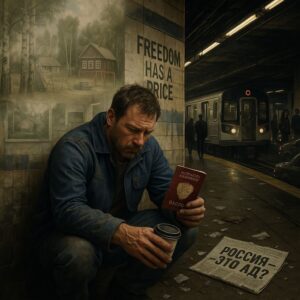 Most people leave to finally—breathe a sigh of relief: a new country, new rules, “here it will definitely become easier.”
Reality turns out to be different.
– 12–15 hour shifts in a warehouse or in a taxi.
– Bills for rent, insurance, and transportation eat up almost everything left after taxes.
– Restless sleep, an endless schedule, the feeling of constantly being behind on something.
The internal dialogue is simple: “I just need to endure, a little longer. I chose this myself.” And the person endures: fatigue, humiliation, loneliness. And most importantly—the fear of admitting that everything turned out not as dreamed. The harder it actually is, the louder the slogans—to justify the daily stress.
But the real pain begins when former compatriots abroad start talking about Russia as if it were a personal enemy.
Anything good—silence. Any problem—a reason to spit on the past. From the inconvenient facts about their new life, a legend of “the price of freedom” is constructed. Fatigue is “part of the journey,” difficulties are a “challenge.”
These people rarely shout about their success. But when they hear their homeland being trashed, they ask one question: “Why so much hatred for the country that gave you your language, education, and the very opportunity to leave?”
The answer is simple: this is not mature criticism. This is not an honest analysis. This is a panicked defense against internal conflict. Instead of admitting disappointment—devaluing the past. Instead of an honest comparison—an abrupt severance and a loud declaration.
America is not paradise. Russia is not hell. As long as happiness is built on charred memories, the migrant remains captive to their own deception—not at the borders, but to that very “old pain” they wanted to leave behind.
Emigration Then and Now: Tragedy, Brand, and the Illusion of an Upgrade
 Emigration in the past was about survival. It was a step into the void. People left because the alternative was death. War, repression, famine. They left their homeland in tears, with children in their arms, without knowing the language, without plans, without guarantees. They left not for “new opportunities,” but because staying was terrifying. It was an act of desperation. A feat, followed by pain, fear, and loss. Departure was perceived as a tragedy, not as a strategy.
Today, everything is different. Emigration has become convenient. It no longer requires suffering. It’s not an escape—it’s an upgrade. A prepared, planned, logistically precise upgrade. Everything is under control: a lawyer will write that you are a “refugee,” a chat group will advise how to properly build your case, YouTube will teach you how to speak at the interview, how to “cry according to instructions,” how to frame your story so it sounds as tragic as possible. A legend of suffering can be assembled like a construction set—and then sold to everyone around. And then you can calmly fly back to the “country of evil” from which you supposedly “escaped.” Where is the feat here? Where is the fear? Where is the risk?
This is no longer a sacrifice—it’s a transaction. A rational project: prepared, left, adapted. New status, new life, new Instagram. You don’t have to actually experience pain; it’s enough to sell it well to others.
But the paradox is that many continue to wear the mask of “fugitives.” They talk about themselves as if they’ve been through hell, when in reality they just got tired of living in discomfort. They didn’t leave because of misfortune—they left out of boredom, out of routine, from a feeling of stagnation. Not exiles, but dissatisfied consumers who decided that in another supermarket the shelves are better stocked and the service is more pleasant.
This is the biggest transformation. Emigration has ceased to be a tragedy—it has become a technology. An app. An instruction manual. An online course. Not intuition—but a step-by-step guide. Not fate—but a choice.
Globalization: One World with Different Signs
 The new world used to be a different planet: unfamiliar products, foreign speech, a different rhythm of life. You changed countries—and lost everything familiar. It was a risk. It was an ordeal.
Today, everything is different. Globalization has turned the world into a huge network of copies. Starbucks and McDonald’s—on every corner. Zara, Apple Store, Netflix—the same interface in any country. You don’t leave your comfort zone—you simply log in from a different region. The differences are decorative: a different flag, a different accent, different names on price tags. But the essence—is the same.
The rich live without borders. For the rest—the illusion of change
For wealthy people, the planet has long become a single VIP lounge. Paris, Dubai, Los Angeles—the difference is only in the climate and exchange rate. A flight is not an escape, but a whim. It’s freedom without effort.
But for the majority—it’s not like that. For ordinary people, emigration is not an upgrade, but simply a transfer of the same problems to a different location. It’s not a new start—it’s a new fight. Work, rent, insurance, bills, searching—all the same, just in a different language.
The emigrant continues to be angry at the country, even though the whole world is already the same
The irony is that, having left for a “different” country, many continue to criticize Russia as if they escaped from hell. But the very idea of a “different world”—no longer works. The world is unified. There are differences, but they are not fundamental. Rent is higher somewhere, healthcare is more expensive somewhere else, taxes are stricter somewhere. This is not hell and paradise—these are different configurations of the same system.
Continuing to trash the old country in the new reality is like complaining about one supermarket chain while being in another—with the same assortment, just in different packaging.
Life doesn’t change with a change of country. Only the language of the bill changes Russia, USA, Germany, Italy—the basic realities are the same: rent, taxes, food, healthcare. A person lives paycheck to paycheck. Poverty is global. A security guard in Moscow and a security guard in New York differ only in uniform and currency. The principle is the same: survive, earn, rest for a day—and then survive again.
The illusion of a “rich country” and the reality of living conditions
In Russia, despite income levels, many people have housing—maybe old, maybe inherited, but their own. In the USA, where income levels are higher, a person might rent a room until they are 40—and this is considered normal. An American doesn’t feel the drama—they don’t expect their “own” corner. A Russian, finding themselves in this reality, feels cheated.
This is the key distortion: a country may seem “richer,” but the quality of life—is not necessarily higher. Rent kills the budget, insurance eats the leftovers, tax takes half the salary. Did the world change—or just the sign?
Emigration can be liberation. But only if you know why you are leaving.
The most common mistake is to leave from something: from daily routine, from irritation, from the news, from fatigue. But if there is no clear goal—what you want to build, who you want to become, what opportunities you want to realize—the country quickly turns into just another arena for the same battles.
Because you brought with you everything you were running from: attitudes, patterns, fears, shifting responsibility.
It’s worth leaving not from pain, but towards a dream. Then the move is not an escape, but a step. And even if it’s hard, you will understand what you are going for. But as long as your main motive is “just not here,” you will be disappointed in any “there.”
Conclusion
 This article is not about justifying one country and criticizing another. Nor is it about arguments over where it is better to live. It’s about something else—a sober look at things. About the truth that is easy to overlook.
Emigration is a difficult choice. But it does not automatically grant clarity, freedom, or happiness. It reveals your internal distortions. You thought you would leave—and everything would change. But you remained the same. Just in a different location.
We have seen that most arguments about “where it’s better” are not about facts, but about pain. Defending the new country becomes a defense of one’s decision. Criticizing the old one is a way to avoid guilt, disappointment, or doubt. People are not comparing—they are projecting. And that means they lose the opportunity to truly compare.
Why so fiercely criticize your own country if reality is roughly the same everywhere? Did changing your passport change the rules of the game? Statistics are impartial: in any developed or developing country, about 99% of the
population does not possess the capital that determines real influence and freedom. Whether it’s the USA, Germany, or Russia—the majority of people live paycheck to paycheck, spending most of their income on rent, food, insurance, and debt servicing. If you do not belong to that 1% (or even 10%) of asset owners, you, with high probability, belong to the global majority—those who work for someone else’s system, not those who manage it. Moving may change the currency of your account and the color of your passport, but it very rarely changes this fundamental economic status. The essence remains the same: you either find a way to build your independence within the system, or you continue to justify your dependence on it—now in a new place.
Real emigration is not about geography, but about inner work. It doesn’t matter how many borders you’ve crossed if the old patterns and resentments traveled with you. Change begins not with a visa, but with honesty with yourself.
Sources and Research
· Bankrate. (2024). 64% of Americans Cannot Cover an Emergency Expense of $1000
https://www.bankrate.com/banking/savings/financial-security-january-2024 (Link inaccessible)
· OECD. (2022). US Healthcare Expenditure and Comparison with Other Countries
https://www.oecd.org/en/publications/understanding-differences-in-health-expenditure (Link inaccessible)
· The Commonwealth Fund. (2024). US Ranks Last Among Developed Countries in Healthcare Affordability
https://www.theguardian.com/us-news/2024/sep/18/american-health-system-ranks-last
· Expatistan (2025). Cost of Living Comparison: New York City vs. Moscow
https://www.expatistan.com/cost-of-living/comparison/moscow/new-york-city
· Numbeo. Prices for Housing, Food, and Healthcare in the USA and Russia
https://www.numbeo.com/cost-of-living/
· Pew Research Center. (2019). Migrants and Discrimination
https://www.pewresearch.org/social-trends/2019/04/09/race-in-america-2019
· SBA. Starting a Business in the USA: Legal and Financial Complexities
https://www.sba.gov/business-guide/launch-your-business
Videos (YouTube):
· I Regret Leaving the Russian Federation
https://www.youtube.com/watch?v=2wrT5K_EJXg
· Difficulties and Hardships of Life in Emigration
https://www.youtube.com/watch?v=rrOEZMe5htY
· Moved to the USA and Lost Myself
https://www.youtube.com/watch?v=INx-dPsFrCM
· Life in the USA: Problems and Disappointments
https://www.youtube.com/watch?v=noZw7xSiXlM
· Why Living in the USA is Harder Than in Russia
https://www.youtube.com/watch?v=HkSD9j5G0P8
Here are reliable sources with complete links that support the key ideas of the article:
Globalization of Brands and the Unification of Global Consumption
· Thompson, C. J., & Arsel, Z. (2004). The Starbucks Brandscape and Consumers’ (Anticorporate) Experiences of Glocalization. Journal of Consumer Research, 31(3), 631-642.
Available on JSTOR: https://www.jstor.org/stable/10.1086/425098
· Starbucks Case Study in Japan: On combining global and local elements and how the network adapts the experience to local culture.
https://jbr.japancreativeenterprise.jp/2021/07/06/starbucks_japan_glocalization/
The Influence of Social Media and YouTube on the Decision to Emigrate
· Djalali et al. (2024). The Influence of Social Media in Shaping Migration Decision-Making of Iranian Students in Sweden: A Survey-based Quantitative Study.
https://www.diva-portal.org/smash/get/diva2%3A1873129/FULLTEXT02.pdf (Link inaccessible)
· Hautamäki et al. (2020). Asylum-Related Migrants’ Social-Media Use, Mobility Decisions, and ….
https://www.tandfonline.com/doi/full/10.1080/15562948.2020.1781991 (Link inaccessible)
Social Media, Disinformation, and Illusions of Success
· Migration narratives on social media: Digital racism and subversive migrant subjectivities.
https://firstmonday.org/index.php/fm/article/view/13715/11652 (Link inaccessible)
· Naghdi, G., & Simonovits, B. (2022). Immigrants of Iranian Origin in Sweden. Intersections.
https://intersections.tk.hu/index.php/intersections/article/view/1203/485 (Link inaccessible)
Economic Realities of Migration
· Human capital flight from Iran: the emigration outflow of qualified specialists, linked not directly to the standard of living, but to systemic reasons.
https://en.wikipedia.org/wiki/Human_capital_flight_from_Iran (Link inaccessible)